
Interpretation of Composite Material Molding Process: Vacuum Infusion, Molding, and Autoclave Process
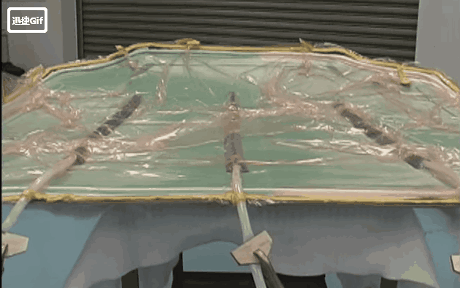
The Vacuum Infusion Process (VIP for short) is to lay reinforcing materials on the mold surface, then lay auxiliary materials such as vacuum bags, and extract the air in the system to form a negative pressure between the vacuum bag and the mold cavity.
The pressure generated by the vacuum process is used to press the resin into the reinforcing materials through the pre-laid pipeline, so that the resin infiltrates the reinforcing materials and finally fills the entire mold. After the product is cured, the auxiliary materials are removed to obtain the desired product from the mold.
Keywords in the Above Introduction:
▪ Reinforcing materials: Reinforcing materials for vacuum infusion are generally dry glass fibers, carbon fibers, sandwich materials, etc.;
▪ Auxiliary materials: Auxiliary materials for vacuum infusion include demoulding cloth, guide nets, vacuum bags, winding tubes, vacuum tubes, etc.;
▪ Resin: The viscosity of the resin system for vacuum infusion is generally 0.15~0.8Pa.S, and the reinforcing materials can only be completely impregnated under vacuum pressure.
Simple Flow Chart of Vacuum Infusion Process:

Schematic Diagram of Vacuum Infusion Process:

Advantages of Vacuum Infusion Process:
Higher Quality Products:
Resin infiltrates reinforcement materials in a vacuum environment, and there are fewer bubbles in the products compared to the traditional hand lay-up process;
Less Resin Loss:
With the vacuum infusion process, the amount of resin can be accurately calculated;
Uniform Distribution Of Resin:
For a product, the pressure generated by the vacuum in different parts is consistent, so the resin infiltration speed and content of the reinforcement material tend to be consistent;
Environmentally Friendly:
The vacuum infusion process is a closed mold process, and VOCs and toxic air pollutants are confined to the vacuum bag, which greatly improves the working environment and expands the range of available materials;
Good Product Integrity:
Reinforcement ribs, sandwich structures, pipelines and other embedded parts can be formed at the same time, which improves the integrity of the product.
Disadvantages of Vacuum Infusion Process:
The Preparation Process Takes Too Long and is Relatively Complicated: it requires the correct laying of release cloth, guide net, effective vacuum sealing, etc.;
It generates a lot of process waste: auxiliary materials such as release cloth, guide net, vacuum bag, etc. are all disposable;
There are certain risks in product manufacturing: especially large and complex structural products, once the resin infusion fails, the product is easy to be scrapped.
Application Areas of Vacuum Infusion Process:
Automotive Industry:
various roofs, windshields, and carriages;
Sports and Leisure:
helmets, windsurfing boards;
Wind Power Energy:
blades, engine room covers;
Boat Industry:
hulls, hull longitudinal beams and frames, decks, steering cabins, radar shields;
Construction Field:
building top parts, building templates;
Agriculture and Horticulture:
granary round covers, agricultural machinery protection covers.
The Following are Some Actual Production Product Examples:

HRC Manufactures the Front Hood of a New Energy Vehicle


HRC Manufactures the Outer and Inner Door Panels of a New Energy Vehicle

Fenders for a New Energy Vehicle

Carbon Fiber Car Seat


Large Yacht Hull
Molding Process
HRC Manufactures a New Energy Vehicle Fender
Molding Process is the oldest and most dynamic molding method in composite material production. It is a method of putting a certain amount of molding material into the metal mold in the press, and curing the molded product under a certain temperature and pressure.
(The SMC molding process introduced in the first issue of the special series is developed from the traditional molding process)
Keywords in the Above Introduction:
▪ Molding Material:
▪ Premixed resin, pre-impregnated fiber after cutting
▪
▪ Metal Mold:
▪ The molding process mold is a closed mold, including an upper mold and a lower mold;
▪
▪ Press:
▪ It is the main equipment of the molding process, which is used to open or close the mold and provide the pressure required for molding. Sometimes it can also be used to provide the heat required for the compression process and eject the product.

HRC Press Equipment
Simple Process Flow Chart of the Molding Process:

Advantages Of Compression Molding:
High production efficiency, easy to achieve specialized and automated production;
High product dimensional accuracy and good repeatability;
Smooth surface, no secondary modification required;
Can mold complex products in one go;
Can be mass-produced at a relatively low price.
Disadvantages of compression molding:
High initial investment cost (metal molds, hot presses);
Complex mold design and manufacturing;
Product size is limited by equipment, generally only suitable for the preparation of small and medium-sized products.
The Main Applications of Compression Molding Include:
Automotive Field:
upper door section, lower door section, water-cut reinforcement plate, grille, tail wing, etc.;
Industrial Field:
Mechanical rod, etc.
Other industries and usage scenarios with demand for small and medium-sized composite products can be applied
Product Examples Manufactured by Compression Molding:

Mechanical Lever Manufactured

Automotive Engine Air Filter Box Manufactured by HRC
Autoclave Process
The autoclave process refers to the process of laying the prepreg on the mold according to the layering requirements, sealing it in a vacuum bag and putting it into the autoclave, heating and pressurizing it through the autoclave equipment to complete the material curing reaction, so that the prepreg blank becomes the required shape and meets the quality requirements of the component.
Keywords in the Above Introduction:
▪ Prepreg: It is a combination of resin matrix and reinforcement made by impregnating continuous fibers or fabrics with resin matrix under strictly controlled conditions. It is an intermediate material for manufacturing composite materials;
▪ Autoclave: Autoclave is a process equipment designed for the characteristics of polymer-based composite material molding process.

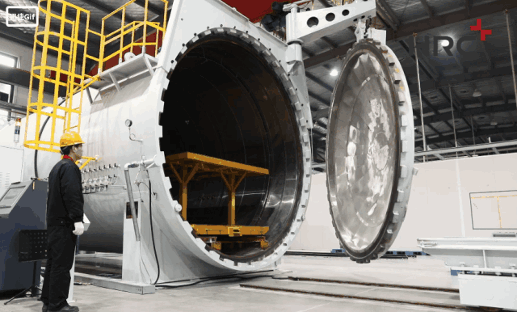
HRC Autoclave Equipment
Simple Autoclave Process Flow Chart:

Autoclave Packaging Diagram:

Advantages of Autoclave Process:
Uniform Pressure Inside The Tank:
Compressed air or inert gas (N2, CO2) or mixed gas is used to inflate and pressurize the autoclave, and the pressure acting on the normal line of each point on the surface of the vacuum bag is the same, so that the component is formed and cured under uniform pressure;
Uniform Air Temperature Inside The Tank:
The heating (or cooling) gas circulates at a high speed in the tank, and the gas temperature at each point in the tank is basically the same. Under the premise of a reasonable mold structure, it can ensure that the temperature difference at each point during the heating and cooling process of the component sealed on the mold is not large;
Wide Range Of Applications:
The mold is relatively simple and efficient, suitable for the molding of large-area complex-shaped skins, wall panels and shells, and can be used to mold various complex structures and parts of different sizes. The temperature and pressure conditions of the autoclave can almost meet the molding process requirements of all polymer-based composite materials;
Stable and Reliable Molding Process:
The pressure and temperature in the autoclave are uniform, which can ensure the stable quality of the molded parts. The components manufactured by the autoclave process have low porosity and uniform resin content. Compared with other molding processes, the mechanical properties of the parts prepared by the autoclave process are stable and reliable. So far, most composite parts requiring high load in the aerospace field are made by the autoclave process.
Disadvantages Of The Autoclave Process:
Large investment and high cost: Compared with other processes, the autoclave system is large and complex in structure. It is a pressure vessel. It is very expensive to invest in a large autoclave. Each curing process requires a large amount of expensive vacuum bags, sealing strips, isolation films, breathable felts, demolding cloths and other auxiliary materials. At the same time, a large amount of water, electricity, gas and other energy is consumed during molding.
The Main Applications Of The Autoclave Process Include:
Aerospace Field: skin parts, ribs, frames, fairings, etc.;
Automotive Field: body panels and body structural parts, such as hood inner and outer panels, door inner and outer panels, roof, fenders, door sill beams, B-pillars, etc.;
Rail Transit: pillow beams, side beams, etc.; Boat industry, high-end consumer goods, etc.
The autoclave process is the main method for manufacturing continuous fiber reinforced composite parts. Widely used in high-tech fields such as aerospace, rail transportation, sports and leisure, and new energy, composite materials products produced by autoclave process account for more than 50% of the total composite materials product output, and the proportion in the aerospace field is as high as more than 80%.
Product Examples Manufactured by Autoclave Process:

Carbon Fiber Roof for New Energy Vehicles Manufactured

Carbon Fiber Luggage Box for New Energy Vehicles Manufactured

Carbon Fiber Side Panels for New Energy Vehicles Manufactured

Racing Boat Hull

The Internal Modules Of The Hull (Yellow is the Injected Composite Material)

Hull Module types of composite materials bag infusion.
IF COMPOSITE MATERIAL IS NEEDED, PLEASE GET A HOLD OF US IN WHICHEVER WAY IS MOST CONVENIENT. WE WILL REPLY YOU WITHIN 24 HOURS.

