
Vacuum Infusion Process – Carbon Fiber Automotive Parts Production Process
The Vacuum Infusion Process (VIP for Short) is to lay reinforcing materials on the mold surface, then lay auxiliary materials such as vacuum bags, and extract the air in the system to form a negative pressure between the vacuum bag and the mold cavity. The pressure generated by the vacuum process is used to press the resin into the reinforcing materials through the pre-laid pipeline, so that the resin infiltrates the reinforcing materials and finally fills the entire mold. After the product is cured, the auxiliary materials are removed to obtain the desired product from the mold.
Keywords in the Above Introduction:
▪ Reinforcing materials: Reinforcing materials for vacuum infusion are generally dry glass fibers, carbon fibers, sandwich materials, etc.;
▪ Auxiliary materials: Auxiliary materials for vacuum infusion include demoulding cloth, guide nets, vacuum bags, winding tubes, vacuum tubes, etc.;
▪ Resin: The viscosity of the resin system for vacuum infusion is generally 0.15~0.8Pa.S, and the reinforcing materials can only be completely impregnated under vacuum pressure.
Simple Flow Chart of Vacuum Infusion Process:

Schematic Diagram of Vacuum Infusion Process:

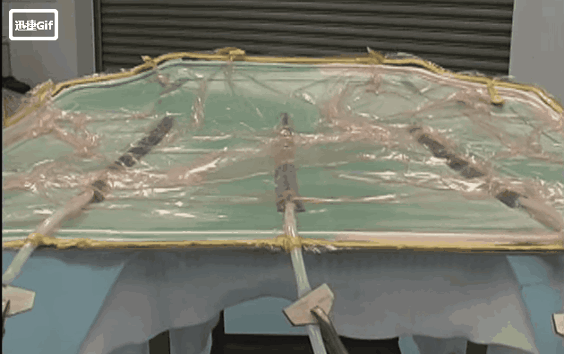


Advantages of Vacuum Infusion Process:
Higher quality products: Resin infiltrates reinforcement materials in a vacuum environment, and there are fewer bubbles in the products compared to the traditional hand lay-up process;
Less resin loss: With the vacuum infusion process, the amount of resin can be accurately calculated;
Uniform distribution of resin: For a product, the pressure generated by the vacuum in different parts is consistent, so the resin infiltration speed and content of the reinforcement material tend to be consistent;
Environmentally friendly: The vacuum infusion process is a closed mold process, and VOCs and toxic air pollutants are confined to the vacuum bag, which greatly improves the working environment and expands the range of available materials;
Good product integrity: Reinforcement ribs, sandwich structures, pipelines and other embedded parts can be formed at the same time, which improves the integrity of the product.
Disadvantages of Vacuum Infusion Process:
The preparation process takes too long and is relatively complicated: it requires the correct laying of release cloth, guide net, effective vacuum sealing, etc.;
It generates a lot of process waste: auxiliary materials such as release cloth, guide net, vacuum bag, etc. are all disposable;
There are certain risks in product manufacturing: especially for large and complex structural products, once the resin infusion fails, the product is easy to be scrapped.
Application Areas of Vacuum Infusion Process:
Automotive Industry: various roofs, windshields, and carriages;
Sports and Leisure: helmets, windsurfing boards;
Wind Power Energy: blades, engine room covers;
Boat Industry: hull, hull longitudinal beams and frames, decks, steering cabins, radar shields;
Construction Field: building top parts, building templates;
Agriculture and Horticulture: granary dome covers, agricultural machinery protection covers.
This process is widely used in some sports cars or modified cars
Here are some actual production product examples:
IF COMPOSITE MATERIAL IS NEEDED, PLEASE GET A HOLD OF US IN WHICHEVER WAY IS MOST CONVENIENT. WE WILL REPLY YOU WITHIN 24 HOURS.

